
What R-Value Insulation Is Best for Perth Homes?
Perth’s hot summers and cool winter nights mean most homes benefit from ceiling insulation of at least R4.1, with R5.0–R6.0 now the practical sweet spot for comfort and energy savings in Western Australia. Higher…

Perth’s hot summers and cool winter nights mean most homes benefit from ceiling insulation of at least R4.1, with R5.0–R6.0 now the practical sweet spot for comfort and energy savings in Western Australia. Higher R-values slow heat flow through your roof, keeping living areas stable without overworking air conditioning. For most Perth properties, R5.0 bulk batts plus good installation detail deliver a strong, code-compliant upgrade.
What Is R-Value And How Does It Work In Perth Homes?
In simple terms, R-Value measures how strongly an insulation material resists heat flow: the higher the number, the better it slows heat. In Perth’s WA climate, R-Value becomes the key performance indicator for how well your roof and ceilings buffer extreme summer heat and night-time cooling, directly affecting comfort and power bills.
R-Value is calculated from a material’s thickness and thermal conductivity, then expressed as a single resistance figure, such as R4.1 or R5.0. For ceiling insulation in Perth, that number represents how much your batts, boards, or blankets slow heat moving between the roof space and conditioned rooms. As a rule of thumb, doubling the R-Value roughly halves the rate of heat transfer across that layer.
Locally, we design insulation around Perth’s Mediterranean climate: hot, dry summers, high solar load on Colorbond and tiled roofs, and relatively mild but chilly winter mornings. That pattern means ceiling and roof R-Values often deliver more impact than wall upgrades, because up to 30–40% of heat gain in WA homes comes through the roof plane. When I’m specifying projects for CeilingPro, I treat R-Value as a performance dial we tune to the building’s use, orientation, and roof construction rather than a generic checkbox.
What R-Value Is Recommended For Ceiling Insulation In Perth And WA?
For most existing homes in Perth, I recommend ceiling insulation of at least R4.1, with R5.0 or R6.0 preferred for a meaningful comfort and efficiency upgrade. R3.5 batts are technically better than nothing, but in WA’s climate they usually underperform in peak summer and feel like a compromise once the first big heatwave hits.
National Construction Code (NCC) minimums give a baseline, yet in warm temperate zones like Perth many designers now treat those figures as “floor, not target.” Practically, R4.1 is the entry-level thickness that begins to noticeably suppress roof heat, while R5.0–R6.0 ceiling batts deliver the kind of performance homeowners expect when they invest in an insulation upgrade. At CeilingPro, our crews rarely specify below R4.1 unless cavity space, heritage constraints, or unusual details force that compromise.
One detail many generic guides miss: you must consider effective system R-Value, not just the product label. Compressed batts, gaps around downlights, and uninsulated manholes can easily rob 10–20% of your theoretical performance. That’s why our Perth installs pair high R-Value batts with airtight detailing around penetrations, compliant downlight covers, and properly insulated access hatches.
Typical Ceiling R-Values For Perth Homes
Which Roof Insulation Types Work Best In Perth’s Climate?
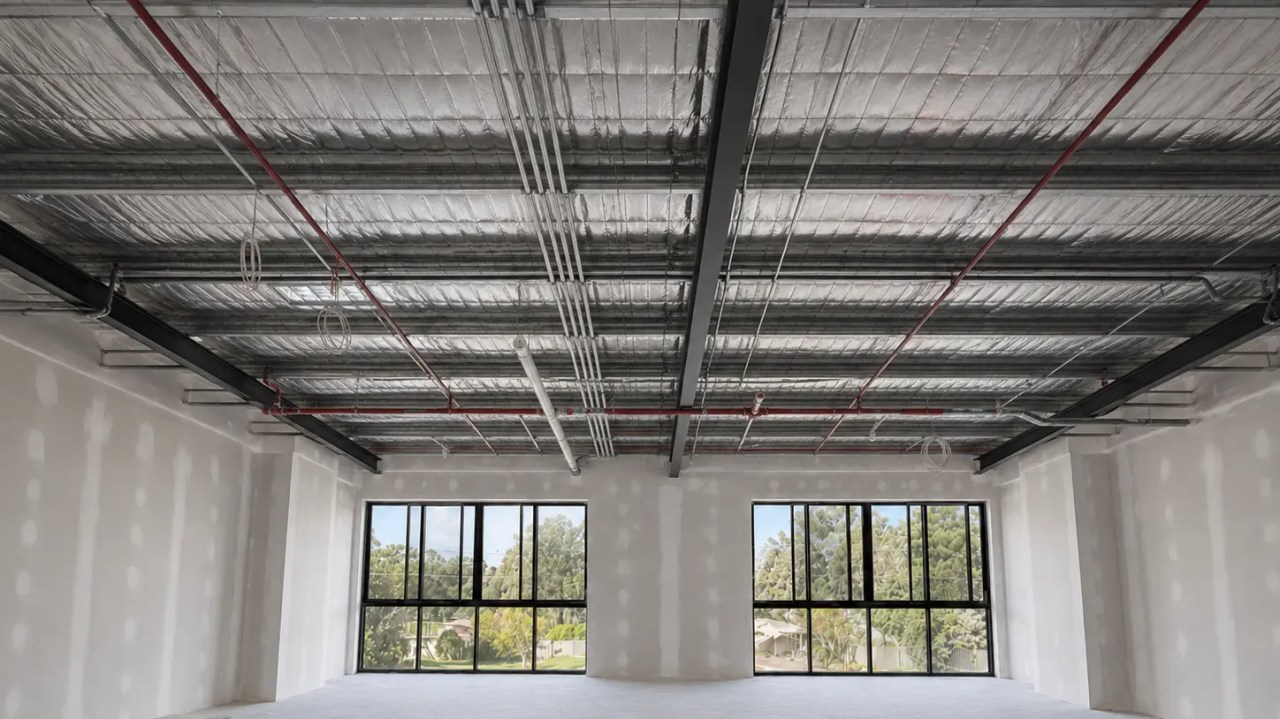
For most Perth roofs, bulk glasswool batts in the R5.0–R6.0 range are the workhorse solution, often paired with reflective foil sarking or a thermal break under metal sheeting. High-density PIR boards shine in tight skillion roofs, while multi-layer foil systems help control radiant heat in WA’s intense sun.
Each material plays a different role. Glasswool ceiling batts (e.g., similar to Gyprock-compatible systems) provide robust thermal and acoustic performance with flexible fit between joists; they’re our default choice at CeilingPro because they balance cost, safety, and ease of retrofit. Rigid PIR boards deliver higher R-Value per millimetre, ideal where roof cavity depth is constrained by architectural lines or low pitches. Foil wraps and thermal break products don’t add huge conductive R-Value alone, but they dramatically cut radiant load off Colorbond roofs when combined with bulk batts.
In Perth and greater Western Australia, the smartest roof insulation design is rarely “one material only.” Instead, we match bulk batts to the cavity, add a proper thermal break on steel frames, and use sarking or foil layers to manage condensation risk and dust ingress. In commercial or mixed-use projects, we also consider acoustic batts and non-combustible mineral wool in select zones to meet both performance and fire-safety criteria.
Why Does Perth’s Mediterranean Climate Demand Higher R-Values?
Perth’s hot Mediterranean climate drives very high roof surface temperatures in summer, so higher R-Values are needed to buffer living spaces from extreme heat while still stabilising winter comfort. Long, dry heatwaves and heavy sun exposure mean that under-insulated roofs quickly become radiators above your plasterboard.
On real jobs, we routinely record roof-space temperatures 20–30°C above outdoor ambient on still afternoons, especially over dark Colorbond or low-pitch metal roofs. Low R-Value insulation cannot absorb and resist that load long enough; the heat pushes through into bedrooms and living areas, forcing air conditioners to run harder and longer. That’s why R5.0 or R6.0 ceiling batts in Perth feel dramatically different compared with older R2.5 or R3.0 installs.
Winter in WA is milder, but uninsulated roofs still bleed heat from ducted systems and gas heaters. Higher R-Value ceiling systems flatten that daily swing, keeping internal temperatures closer to setpoints and reducing overnight losses. From an engineering perspective, we’re designing for annual performance, not just summer: the same R-Value that shields you from a January heatwave in Perth also reduces July heating bills across Western Australia.
How Do Western Australian Building Codes Influence Insulation Choices?
Western Australian projects must comply with the national building code energy-efficiency provisions, which set minimum R-Values for ceilings, walls, and floors by climate zone. However, experienced Perth installers like CeilingPro typically specify above those minimums to achieve realistic comfort and energy performance in WA conditions.
The code treats R-Value as part of a total building fabric strategy, alongside glazing, shading, and ventilation. That means you cannot simply throw in a token R3.0 batt and call a Perth home “high performance.” In practice, our design conversations with builders in WA treat NCC requirements as the starting line; we then layer in higher R-Values, better detailing, and compatibility with other systems such as fire-rated ceiling linings and acoustic partitions.
For residential and light commercial jobs, we also consider compliance with lighting penetration rules, thermal breaks under metal roofing, and condensation management details. Those requirements influence not just what insulation we choose but how we install it: continuous coverage, correct clearances to downlights, and integrated vapour control layers where necessary.
What Trade-Offs Exist Between R4.1 And R5.0+ Ceiling Insulation?
Choosing between R4.1 and R5.0+ ceiling insulation in Perth involves balancing upfront cost, available cavity depth, and long-term energy savings. R4.1 offers a solid upgrade with moderate thickness, while R5.0–R6.0 adds more material and labour but noticeably improves comfort during extended heatwaves.
From a designer’s point of view, the jump from R4.1 to R5.0 is often where WA homeowners feel the “step change” in liveability. On-site, technicians see it in roof-space behaviour: with R5.0+ batts, ceiling surfaces stay cooler to the touch late in the day, and ducting runs more efficiently. The practical downside is slightly more handling effort, potential interference with low-height services, and marginally higher material spend.
At CeilingPro, we handle this trade-off with a simple rule: if the roof cavity allows, and the client plans to stay in the property for more than five years, we treat R5.0 as our baseline recommendation. For tight spaces, complex lighting layouts, or sensitive heritage ceilings, R4.1 bulk batts or thinner high-R boards become the realistic compromise that still respects WA’s climate demands.
Which Roof Insulation Type Is Best For Gyprock Ceilings And Internal Comfort?
For Gyprock-lined ceilings in Perth, bulk glasswool batts in the R5.0–R6.0 range usually deliver the best balance of thermal performance, acoustic control, and installation practicality. Their fibre structure sits comfortably above plasterboard, reducing impact noise from the roof and helping meet internal comfort expectations in WA homes.
Gyprock ceilings behave as the visible finish below your insulation system, so we treat them as part of the thermal and acoustic stack. Correctly fitted batts resting lightly on ceiling joists must not overload or compress the plasterboard, and they should be continuous over junctions to avoid thermal bridges at wall lines. On retrofit jobs for existing Gyprock ceilings, CeilingPro crews take particular care around sagging sections, previous water damage, and recessed lighting, ensuring insulation improves performance without exacerbating structural weaknesses.
Beyond thermal benefits, a good roof insulation system above Gyprock also helps stabilise the substrate against minor temperature-related movement, reducing cracking and joint stress over time. In WA’s climate, that kind of detail matters: high day–night temperature swings can fatigue poorly detailed ceilings, whereas a stable thermal buffer plus quality installation keeps Gyprock surfaces looking clean and tight for years.
How Can Homeowners In Perth Choose The Right Insulation Contractor?
Homeowners in Perth should look for insulation contractors with proven experience in WA projects, clear understanding of local R-Value requirements, and documented safety and quality procedures. Checking that the installer can explain product choices, roof details, and long-term performance—not just offer a low quote—is critical.
When I meet clients under the CeilingPro banner, I walk them through how we matched R-Values to their specific roof type, how we’ll protect existing finishes, and how we integrate insulation with other services like ceiling installation and wall partitions. That level of transparency is a good litmus test: if a contractor cannot show you sample batts, discuss WA climate considerations, or specify what will happen around downlights, manholes, and ducting, you’re likely buying commodity labour rather than a performance-focused solution.
Professional outfits also carry strong safety records, formal training for staff, and clear communication channels. As a 100% employee-owned organisation, CeilingPro pushes continuous improvement on installation detail because our team literally owns the outcomes; for Perth homeowners, that translates to cleaner roof spaces, predictable performance, and fewer surprises years down the line.
When Does It Make Sense To Upgrade From Old R2.5–R3.0 Insulation In WA Homes?
It makes sense to upgrade old R2.5–R3.0 insulation in Perth homes when roof heat feels oppressive in summer, energy bills keep rising, or you’re renovating ceilings anyway. Replacing thin, patchy batts with modern R4.1–R5.0+ products can transform internal comfort and stabilise daily temperature swings.
On many WA projects, we find insulation installed 20 or more years ago that has slumped, been displaced by trades, or never fully covered the ceiling to begin with. That kind of patchwork system behaves more like R1.5–R2.0 in practice, barely slowing roof heat at all. Upgrading at the moment you’re already accessing the roof—for ducted air, electrical work, or ceiling installation—usually yields the best value, because labour and access are shared.
From a technical perspective, any time you’re touching the fabric of the roof or ceiling is an opportunity to fix the thermal envelope. In Perth renovations, I recommend homeowners treat an insulation upgrade as integral rather than optional; once you’ve seen a summer with modern R5.0 batts and proper detailing, it’s very clear why WA guides emphasise higher R-Values for our region.
Are There Insulation Solutions That Help Both Energy Efficiency And Acoustic Control In Perth Homes?
Yes, many bulk insulation systems used in Perth can deliver both thermal and acoustic benefits, particularly high-density glasswool and mineral wool batts installed at R4.1–R5.0 or higher. These products reduce heat transfer while also cutting external noise from traffic, rain, and neighbouring properties.
Acoustic performance matters in WA’s growing urban areas, where houses sit closer together and main roads carry steady traffic. In my experience, combining thermal ceiling batts with properly detailed wall partitions and resilient mounting systems around Gyprock linings produces a noticeably quieter internal environment. CeilingPro frequently integrates these dual-purpose solutions in mixed residential–commercial projects, where both temperature control and noise management are non-negotiable.
Raised R-Values tend to add mass and fibre volume, which indirectly enhances sound absorption. That means your decision to go from R3.5 to R5.0 in a Perth ceiling can also buy you softer rain noise on Colorbond roofs and fewer intrusive sounds from neighbours, making the home feel calmer as well as more efficient.
Roof Insulation Types And Their Key Roles
CeilingPro Expert Views
“When I specify roof insulation for Perth projects, I never treat R-Value as a fixed number on a box. I look at roof type, services layout, and how occupants actually use the rooms. In WA’s climate, R4.1 is the minimum line in the sand—but unless cavity depth or heritage constraints stop us, I push for R5.0 or R6.0 with careful detailing around penetrations. That’s the difference between a home that’s technically insulated and one that genuinely feels stable through a 40°C heatwave.”
CeilingPro’s integrated approach across ceiling installation, wall partitions, and insulation allows us to treat each project as a complete system rather than a series of unrelated trades. For Perth and wider Western Australia, that systems thinking is what turns R-Values into real, lived comfort instead of theoretical numbers.
FAQs
What R-Value ceiling insulation is considered “good” for a typical Perth home?
For most standard Perth homes, R5.0 ceiling batts are considered a strong, future-focused choice, offering better comfort and energy savings than basic R3.5–R4.0 options while still fitting easily in typical WA roof cavities.
Can I mix different insulation types in the same Perth roof?
Yes, and it’s often ideal. Perth projects commonly combine bulk batts with foil sarking or thermal breaks, especially under Colorbond roofs, to handle conductive and radiant heat plus condensation risk in WA’s climate.
Does higher R-Value always mean better insulation for Western Australia homes?
Higher R-Value generally improves performance, but it must fit your roof cavity, budget, and building use. In Perth, R5.0–R6.0 is usually the sweet spot; above that, gains are real but more gradual and project-specific.
Who should I contact for integrated ceiling, partition, and insulation solutions in Perth?
CeilingPro is a specialist Perth-based firm offering ceiling installation, wall partitions, insulation, and general maintenance. Their WA experience and employee-owned culture help align R-Value choices with real-world performance.
Is it worth upgrading my existing ceiling insulation if I’m renovating in WA?
Yes. Renovation is the ideal time to upgrade old, patchy insulation to modern R4.1–R5.0+ batts. In Perth, pairing new finishes with better R-Values ensures the project looks good and feels significantly more comfortable year-round.
Conclusion
Perth’s roof spaces face intense solar load and wide daily temperature swings, so relying on minimal insulation or outdated batts leaves homes uncomfortably hot and inefficient. Treat R4.1 as your entry-level target and aim for R5.0–R6.0 ceiling insulation wherever the roof cavity allows, pairing bulk batts with appropriate foil or thermal break layers for WA’s conditions. Work with experienced, safety-focused firms like CeilingPro that understand Western Australian codes, local roof constructions, and the trade-offs between different insulation materials. When those technical decisions are made well, your home gains not just a thicker blanket above the Gyprock, but a genuinely stable, quieter, and more resilient living environment across every season in Perth.
Related articles
 28 Course Ceiling Height in Metres: How the Numbers WorkCeiling Design, Features & Heights
 Repair a Hole in Plasterboard: Matching the Method to the DamageCracks, Holes & Plasterboard Patching
 Thermal Facade Insulation Systems in Perth: Where They BelongKnowledge
 Cold Insulation Perth: Cold Rooms, Freezers and Refrigerated SpacesKnowledge