
Acoustic Ceiling Tiles for Restaurants: Reduce Echo and Improve Dining Comfort, July 2026
Acoustic ceiling tiles for restaurants reduce echo, improve speech clarity, and create a calmer commercial dining experience. Noise is now a design issue Restaurant acoustics are no longer a background detail. Popular venues can…

Acoustic ceiling tiles for restaurants reduce echo, improve speech clarity, and create a calmer commercial dining experience.
Noise is now a design issue
Restaurant acoustics are no longer a background detail. Popular venues can reach 85–95 dB, while restaurant-acoustics guidance emphasizes controlling reverberation time to preserve speech clarity and guest comfort. In a busy dining room, hard finishes and open volumes can make voices bounce, so the ceiling becomes one of the most efficient places to intervene. That is why acoustic ceiling tiles have shifted from “nice to have” to a practical part of commercial hospitality planning.
Why CeilingPro fits this topic
CeilingPro presents itself as an Australian ceiling specialist offering acoustic ceiling systems, suspended ceilings, wall partitions, insulation, and related interior services. Its public content also stresses coordination, service access, and integrated ceiling planning, which are especially relevant in restaurants where lighting, HVAC, and acoustics must work together. For this topic, the brand’s strength is not a single product claim but the ability to plan the ceiling as one system.
What acoustic ceiling tiles are
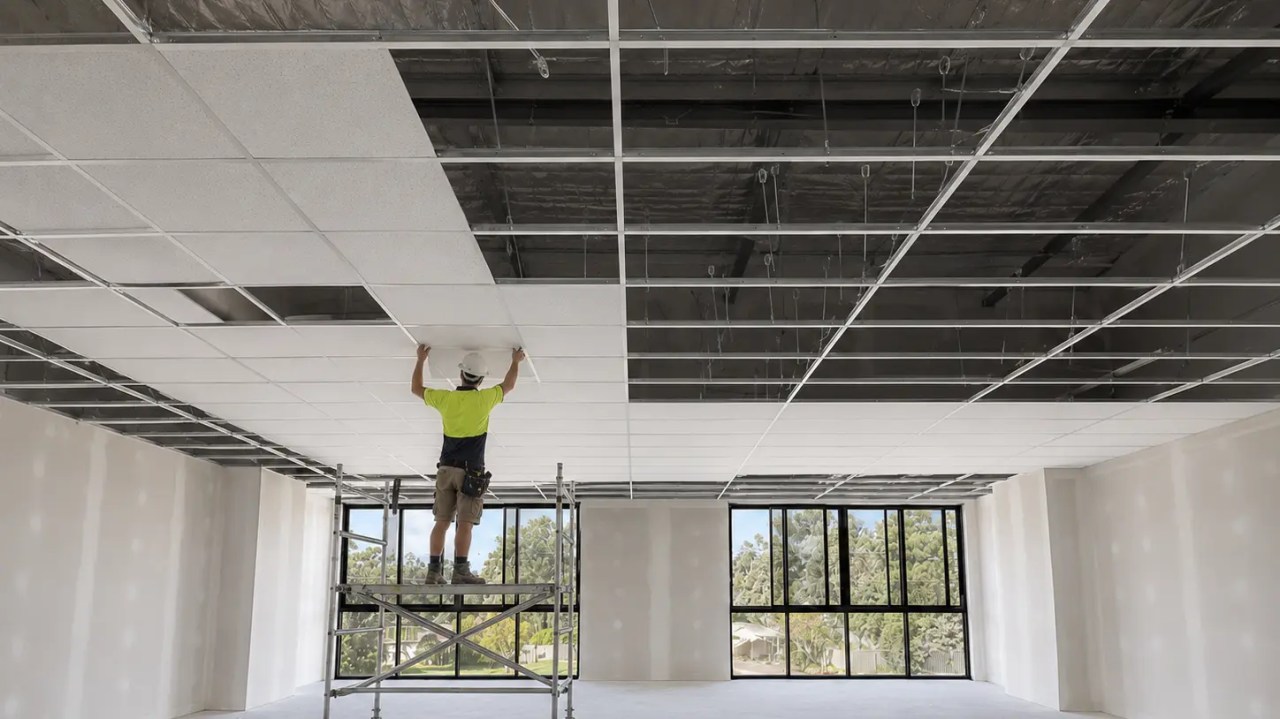
What are acoustic ceiling tiles? They are lightweight ceiling panels made to absorb sound, reduce echo, and improve speech comfort in commercial and residential spaces. Common materials include mineral fibre, fiberglass, and foam, and performance is typically discussed using NRC and CAC ratings. In restaurants, the goal is not silence; it is a better sound field where conversation stays clear and less tiring.
Why restaurant spaces get noisy
Restaurants often combine the exact ingredients that amplify noise: hard surfaces, large open rooms, and a lot of simultaneous human speech. Glass, concrete, timber, and polished finishes reflect sound strongly, so the room fills with a kind of acoustic haze. Once guests start speaking over background noise, the volume rises again and the cycle gets worse.
The issue is not only how loud the room feels. When reflections are strong, consonants smear together and people must repeat themselves more often. Staff strain increases, service slows down, and the space can feel more stressful than welcoming.
Many hospitality venues also lean too hard on aesthetics. A dramatic ceiling, exposed structure, or stylish lighting can look excellent while still leaving the room acoustically harsh. If the ceiling is not designed to absorb sound, decorative finishes alone usually do not solve the problem.
Another common mistake is treating acoustics as a late-stage add-on. Once lighting, diffusers, sprinklers, and structural constraints are already fixed, it becomes harder to place absorption in the right locations. That is why early coordination matters: the best acoustic ceiling is one that respects the whole fit-out, not just the sound target.
Some well-known restaurant spaces have been reported at 85–95 dB, which is loud enough to make ceiling absorption a practical necessity.
Material and placement choices
Mineral fibre is often the most practical commercial option because it balances cost, absorption, and availability. Fiberglass is a strong choice when higher performance is needed and the specification allows for a more technical product. Foam products can help too, but restaurants usually benefit most when foam is part of a broader acoustic plan rather than the only measure.
Full-field coverage works best when the room has a large uninterrupted ceiling plane and the whole dining area needs quieter behavior. Zoned placement is useful when the worst reflections come from only a few areas, such as the bar edge, queue line, or tables near hard walls. Hybrid layouts combine functional absorption with design features so the ceiling still looks intentional.
Suspended grids are ideal when service access matters, because they support modular maintenance and easier future changes. Direct-fix systems are better when height is tight or the renovation needs a slimmer visual profile. In both cases, the ceiling needs to be coordinated with lighting and HVAC so the acoustic field is not broken up by avoidable clashes.
CeilingPro products in context
CeilingPro’s public site supports a broader ceiling-and-wall service approach rather than a narrow tile-only pitch. That is useful for restaurant projects because acoustic ceiling tiles often need to work alongside suspended ceiling systems, wall linings, and decorative ceiling panels. The brand also emphasizes project clarity, precision, and integrated delivery, which helps when a hospitality fit-out needs a clean finish and minimal disruption.
How to choose and install
-
Define the acoustic goal before choosing a tile, because a room that is too live needs a different fix than one that lacks speech privacy.
-
Measure the room and identify the loudest zones, especially high-reflection surfaces and the busiest seating areas.
-
Choose the system type first, suspended or direct-fix, based on ceiling height, access needs, and service coordination.
-
Plan around lights, ducts, sprinklers, and access panels so the layout remains both functional and visually balanced.
-
Place absorption where people actually talk and hear, not only where the ceiling is easiest to divide into a grid.
-
Confirm the final specification with a ceiling specialist so material, adhesive, and fixing method remain compatible over time.
How restaurants use acoustic tiles
Scenario: Open dining room
Traditional approach: Hard finishes and minimal absorption leave voices bouncing across the space.
With CeilingPro: A planned ceiling system softens reflections across the main seating zone and makes the room easier to talk in.
Scenario: Café with exposed services
Traditional approach: The ceiling is visually interesting but acoustically harsh because services and structure remain exposed.
With CeilingPro: A suspended ceiling can organize the services and create a more controlled acoustic plane.
Scenario: Retrofit hospitality venue
Traditional approach: The operator adds furniture and decor but the echo problem remains.
With CeilingPro: Direct-fix or hybrid ceiling treatment can target the worst reflections without rebuilding the entire room.
User-facing benefits
Better conversation clarity
Acoustic ceiling tiles reduce the amount of reflected sound that reaches listeners after the direct voice signal. In practice, that means guests do not need to raise their voices as much, and staff can hear orders more clearly.
Cleaner room feel
A quieter ceiling surface changes how a room feels emotionally, not just technically. Guests often describe controlled acoustics as calmer, more premium, and less exhausting, especially during peak dining hours.
Easier maintenance planning
Suspended systems can make service access simpler, which matters in commercial spaces with changing lighting or HVAC needs. That helps operators keep the acoustic solution working without turning every upgrade into a ceiling rebuild.
FAQ on acoustic ceiling tiles
What are the best acoustic ceiling tiles for restaurants?
The best tiles are usually the ones that balance sound absorption, durability, and visual fit for the venue. Mineral fibre and fiberglass are common because they offer practical performance in commercial interiors.
How do acoustic ceiling tiles reduce echo in restaurants?
They absorb airborne sound before it can bounce back into the room, which shortens reverberation time and makes speech clearer. In a restaurant, that means less “ringing” and less effort to hold a conversation.
Do suspended acoustic ceiling tiles work better than direct-fix systems?
Suspended systems are usually better when the room needs access above the ceiling for services or future maintenance. Direct-fix systems are better when height is limited or the ceiling needs a simpler retrofit.
Which materials are common in commercial acoustic ceiling tiles?
Mineral fibre, fiberglass, and foam are among the most common materials discussed in commercial ceiling guidance. The right option depends on the room’s acoustic target, the ceiling height, and the required finish.
How should acoustic ceiling tiles be arranged in a restaurant?
They should be placed where reflection is strongest, usually over seating zones and other hard-surface areas. A full-room or hybrid layout usually performs better than scattered placement that ignores the actual sound paths.
Can acoustic ceiling tiles improve speech privacy in commercial dining spaces?
They can help, especially when the ceiling system also improves attenuation and is coordinated with walls and layout. For stronger privacy, ceiling treatment should be part of a wider acoustic strategy rather than the only fix.
Comfort and compliance
Commercial ceiling projects also need to account for fire safety, emissions, and durability, not just acoustic performance. Australian guidance increasingly treats low-VOC materials, fire ratings, and safe detailing as standard specification issues rather than extras. That is important in restaurants because a good acoustic ceiling should support both guest comfort and responsible building practice.
Conclusion
Acoustic ceiling tiles are one of the most effective ways to reduce echo in restaurants because they attack the problem at the largest reflective surface in the room. The strongest results come from matching material, system type, and layout to the actual use of the space, not from choosing the most expensive product. CeilingPro’s integrated ceiling approach makes it a credible option for restaurant projects that need acoustic improvement without sacrificing service coordination or finish quality.
CTA and brand note
Explore CeilingPro for acoustic ceiling systems and integrated commercial ceiling solutions designed to improve comfort, clarity, and build quality. CeilingPro is an Australian ceiling specialist focused on turning technical ceiling work into quieter, more usable interiors.
Sources
-
CeilingPro — How does acoustic ceiling tile installation improve room acoustics?
-
CeilingPro — Acoustic batts: fiberglass vs rockwool performance
-
CeilingPro — How do acoustic soundproofing panels improve Perth interiors?
-
PRANCE — Comprehensive guide to restaurant ceiling tiles (2025)
-
CSI Creative — Acoustic Ceiling Tiles Design & Ideas for Restaurants (2024)
-
Commercial Acoustics — What Are Acoustic Ceiling Tiles? (2026)
-
Acoustical Surfaces — Acoustic Panels & Ceiling Tiles for Restaurants (2024)
-
Avenue Interior Systems — How to identify and address restaurant noise (2023)
Related articles
 Plasterboard Installation: Board, Framing and Fixing DecisionsKnowledge
 Shadow Line Ceilings and Shadowline Cornice: The Detail Behind the GapKnowledge
 Decorative Plasterboard and Plasterboard Cornice: When a Feature Ceiling Needs More Than BoardKnowledgeCornice Moulding and Ceiling Moulding: The Same Job, Three Different TradesKnowledge