
Cold Insulation Perth: Cold Rooms, Freezers and Refrigerated Spaces
Cold insulation Perth covers cold rooms, freezers and refrigerated spaces. What the requirement applies to and what to hold after installation.
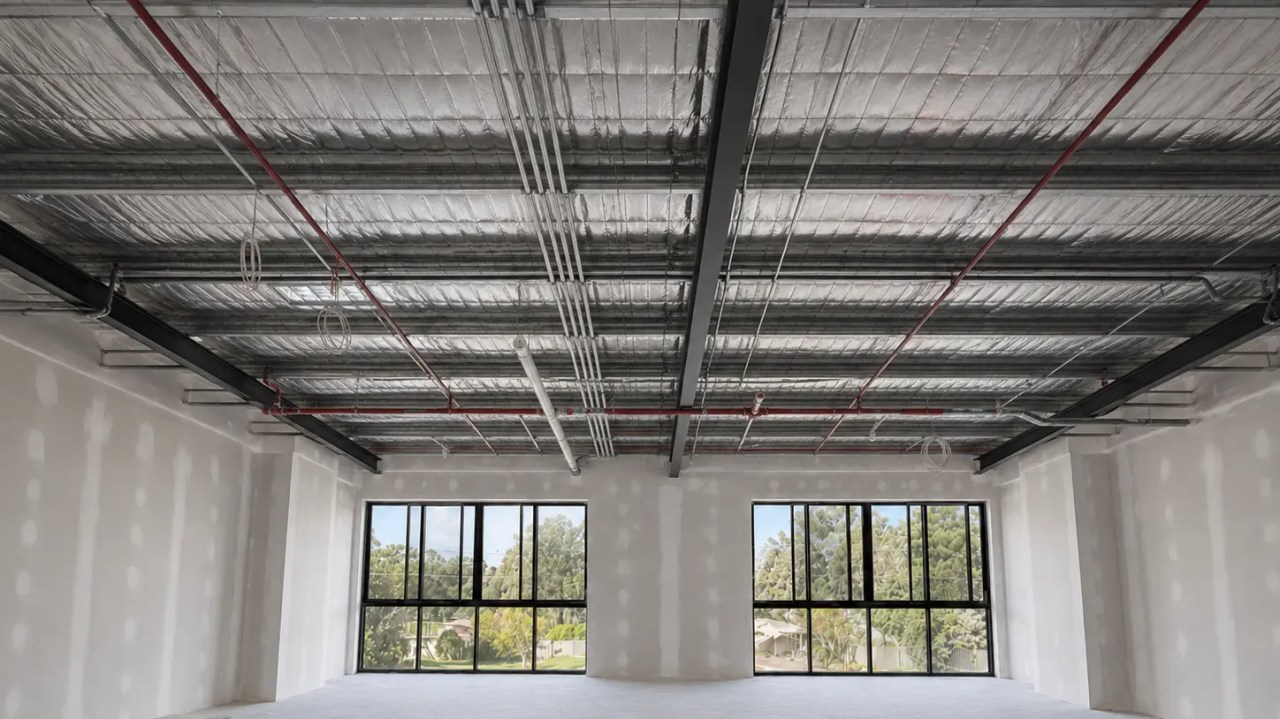
This page sets out what a cold room assembly has to achieve, how it is specified, where it fails, and what should be recorded.
What Cold Insulation Perth Projects Have to Achieve
The assembly has to hold the required temperature with the plant available, exclude moisture from the insulation, and stay sealed at every joint, edge and penetration for the life of the room.
The first job is thermal. A cold room or freezer operates at a temperature well below the surrounding building, so heat flows towards it continuously and the plant has to remove that heat. The rate at which heat arrives depends on the R-value of the assembly, the area of the envelope and the temperature difference across it. Anything that reduces the effective R-value, such as a thermal bridge through a frame or a compressed panel, increases the running load on the plant.
The second job is moisture control, and on a cold room it matters more than the thermal figure. Because the room is colder than its surroundings, water vapour in the warmer air is driven towards it. If that vapour reaches the insulation it condenses, and wet insulation performs far worse than dry insulation. The assembly therefore includes a continuous vapour control layer on the warm side, and the layer is only effective if it is continuous at every joint. The behaviour of moisture in building assemblies is described in the condensation mitigation material published by the Australian Building Codes Board and in the YourHome condensation guidance.
The third job is integrity of the envelope. A cold room is a sealed box, and every penetration for a pipe, a drain, a cable or a door frame is a place where the seal can be broken. The detailing at those points is part of the assembly rather than a finish applied afterwards, and each one belongs in the record.
How a Cold Room Assembly Is Specified
The assembly is specified from the operating temperature and the surrounding conditions inwards: the product, the thickness, the vapour control layer and the detailing all follow from those two inputs.
The operating temperature comes first, because a chiller, a cool room and a freezer place different demands on the assembly. The surrounding conditions come second, because a room inside an air conditioned building sits in a different environment from one in an unconditioned warehouse, and the vapour drive depends on the difference. Those two figures decide the required thickness and the position of the vapour control layer.
The product route follows. A pre-formed insulated panel system is assembled with interlocking joints and sealed at each junction, and its performance depends on the joint detail as much as on the panel. A built-up assembly uses a substrate with insulation and a separate vapour control layer, and its performance depends on the continuity of that layer. Both routes are viable, and the specification has to say which one is intended, because the details are different.
The junctions and penetrations are specified last and are the most demanding part. Where the insulated envelope meets a structural element, a thermal bridge has to be broken or accounted for. Where a pipe or a drain passes through, the seal is detailed so that the vapour control layer remains continuous around the service. Where the floor and the wall meet, the junction is detailed as a single assembly rather than two surfaces meeting, because that corner is where a cold room most often fails.
Products and Performance Targets
The product is chosen for how it performs in the presence of moisture, and the performance target is the operating condition rather than a headline R-value.
| Item | What it controls | Where it is recorded |
|---|---|---|
| Operating temperature | The temperature difference the assembly works across | Design brief and equipment schedule |
| Surrounding conditions | How much vapour is driven towards the room | Building design documentation |
| Product and thickness | The thermal performance of the envelope | Product data and assembly drawing |
| Vapour control layer | Whether moisture reaches the insulation | Assembly drawing and product data |
| Joint and edge detail | Continuity of both the thermal and the vapour layer | Assembly details |
| Penetration treatment | Whether services break the envelope | Services drawings and site record |
Products suited to this application are closed-cell or vapour-resistant, because a product that holds moisture loses performance and does so permanently. A bulk mineral fibre product can be used in some assemblies, but only where the vapour control layer is continuous enough to keep moisture away from it, and that is a demanding condition. The general behaviour of insulation in Australian buildings is described in the YourHome insulation material.
The fittings above and around the room follow the same rule. A suspended ceiling over a chiller, a light fitting set into an insulated panel or a door frame with a heater are all places where the envelope is interrupted. Each is detailed so that the interruption is sealed, and each one is part of the assembly drawing rather than a site decision. The materials and installation framework for these systems is published through Standards Australia.
Installation, Vapour Control and Integrity
Installation decides whether the room performs, and the two things that matter most are the continuity of the vapour control layer and the seal at every junction.
The vapour control layer is installed so that it is continuous across the whole warm side of the envelope, including the junctions with the floor and the ceiling, the edges around openings and the points where services pass through. Sealing the field and leaving the edges is the most common mistake, because the edges are where the vapour pressure is highest. Each lap, each edge and each termination is sealed with a product and a method published for the purpose, and the layer is inspected before it is concealed.
The joints between panels are the second item. Interlocking panels present a joint that is small but continuous, and it is filled and sealed as part of the assembly. Where a panel is cut on site, the cut edge is sealed to the same standard as a factory edge, because a cut edge exposes the core of the panel and often has no facing. A cut edge left unsealed becomes a path for moisture and a place where the panel’s performance degrades.
Thermal bridges are the third item. Where the insulated envelope is interrupted by a structural member, a fixing or a frame, heat passes through that point and the local surface gets colder. On a cold room that is the point where condensation appears, and it is the point where the vapour layer is most likely to be compromised. Breaking the bridge with a thermal separator or detailing around it is part of the design.
The refrigeration plant is a separate scope. The system, the refrigerant pipework and any work on the refrigeration circuit belong with a licensed refrigeration mechanic, and the insulation scope works alongside that trade rather than around it. Safe work practice for construction sites is set out by Safe Work Australia.
Documentation a Client Should Hold
The record should show the assembly, the products and the state of the vapour control layer before it was covered.
The assembly record names the operating conditions the room was designed for, the product and thickness used, and the position of the vapour control layer. The product data for the panels or the built-up assembly sits with it, including the jointing materials and the sealants, because the performance of the assembly depends on all of them. Where a component was substituted during construction, the substitution and its justification belong in the file.
The photographic record is the most valuable part of the pack for a cold room, because the vapour control layer is entirely concealed once the room is finished. Photographs taken before the layer was covered show the lap directions, the seals at the edges and the treatment of every penetration, and they are the evidence that the room was built as designed. They also make a future repair faster, because the position of everything inside the envelope is known.
The commissioning record from the refrigeration contractor sits alongside the insulation record. Together they show that the envelope and the plant were designed as a pair, which is what makes a cold room perform. For the wider insulation scope, see the insulation service page and the ceiling insulation page.
Inspection and Sign-Off
Inspection is staged so that the vapour control layer is verified before it is covered, and the envelope is verified before the plant is commissioned.
The substrate inspection confirms the frame or panel base is complete, dry and free of sharp edges that would damage the vapour layer. The insulation inspection confirms the product, the thickness and the completeness of the cover, including behind services and at the perimeter. The vapour control inspection confirms the layer is continuous, laps are in the right direction and every edge and penetration is sealed, and it is carried out before any lining or ceiling closes the assembly.
The envelope inspection then checks the junctions with the floor, the ceiling and any structural element, and confirms that no thermal bridge is left exposed. Once the room is closed, the check becomes a performance test rather than a visual one, and any cold spot on a surface is a symptom worth recording.
The sign-off record names who inspected each stage and when. Where the room is part of a food business, the surface finish requirements that apply to the space are a separate set of standards from the thermal ones, and both are confirmed before the room is used.

Common Specification Errors
The common errors are a vapour control layer that stops at the perimeter, cut panel edges left unsealed, a thermal bridge left exposed and a product chosen on its headline R-value alone.
A vapour layer sealed in the field but left open at the perimeter is the error that most often causes a cold room to fail early, because the perimeter is where the vapour drive is strongest. A cut edge left unsealed allows moisture into the core of the panel and removes the facing that gives the panel its vapour resistance. A thermal bridge left exposed produces a cold spot and a condensation point that appears before any other symptom.
Choosing a product on its headline R-value alone ignores how it behaves when moisture reaches it. The useful comparison is between products that hold their performance in the conditions the room will actually see, at the thickness the room can accommodate. For the wider construction and insulation scope, the CeilingPro knowledge library covers the related topics in more detail.
Frequently Asked Questions
What is the best cold insulator for a refrigerated space?
There is no single product that suits every refrigerated space, because the choice depends on the temperature, the humidity around the room, and the surface the insulation has to sit behind. What matters most is a closed-cell or vapour-resistant product that holds its performance in the presence of moisture, paired with a continuous vapour control layer. A product with a high R-value still underperforms if moisture reaches it.
What is the highest R-value insulation in Australia?
The highest published R-value depends on the product category and the thickness, so a rigid panel and a bulk batt are not compared on the same basis. For a cold room the useful question is not which product has the highest figure, but which assembly delivers the required performance at the thickness the room can accommodate while keeping the vapour control layer intact. Thickness reduces usable space, and that trade-off is part of the design.
Why does a cold room need a vapour control layer?
A cold room is colder than the air around it, so moisture in the warmer air is driven towards the cooler surface. If that moisture reaches the insulation it condenses inside the assembly, which reduces performance and eventually damages the construction. A continuous vapour control layer on the warm side stops the moisture reaching the insulation, and it has to be continuous at joints, penetrations and panel edges to work.
Does cold room insulation need a licensed trade?
The insulation and lining work is one scope, and the refrigeration plant, the refrigerant pipework and any work on the system are a separate licensed scope that belongs with a refrigeration mechanic. Where a room has to be entered during construction, the entry, ventilation and supervision arrangements are planned before work starts. CeilingPro carries out the lining and insulation scope and works alongside the mechanical contractor rather than around them.
If a Perth project includes a cold room, a freezer or a refrigerated space and the envelope details need to be resolved before the panels go on, send the drawings and the operating conditions through the CeilingPro enquiry form, or email info@ceilingpro.com.au.
Related articles
 28 Course Ceiling Height in Metres: How the Numbers WorkCeiling Design, Features & Heights
 Repair a Hole in Plasterboard: Matching the Method to the DamageCracks, Holes & Plasterboard Patching
 Thermal Facade Insulation Systems in Perth: Where They BelongKnowledge
 Commercial Wall Insulation Perth: Cavity, Thermal and AcousticKnowledge