
How Do You Fix Medical Ceiling Damage Safely?
A damaged medical ceiling can turn into a contamination pathway fast. In dental clinics and hospitals, gaps, cracked tiles, and open penetrations can trap dust, shed particles into clean zones, and worsen infection risk.…

A damaged medical ceiling can turn into a contamination pathway fast. In dental clinics and hospitals, gaps, cracked tiles, and open penetrations can trap dust, shed particles into clean zones, and worsen infection risk. The safest fix is to isolate the area, replace damaged tiles with hygienic, antimicrobial-rated panels, and reseal every joint so the ceiling stays cleanable, durable, and compliant.
clinical and hospital ceiling maintenance
What do top medical ceiling articles say?
Most high-ranking articles in this space focus on three themes: infection control, cleanable materials, and routine tile replacement. They also repeat the importance of reducing dust release during overhead works and choosing ceilings that can handle disinfectants, humidity, and frequent maintenance.
From our Perth work in clinics and healthcare spaces, the real issue is not just the tile itself. It is the entire ceiling line: tile edges, grid joints, light fittings, service penetrations, and any breach that lets airborne particles settle into the plenum and later fall back into treatment areas.
Why are damaged ceiling tiles risky?
A broken ceiling tile is more than an appearance issue. In a clinic, it can become a catchment point for bioaerosols, skin flakes, lint, and dust, then release that load when the tile shifts, the HVAC cycles, or maintenance work disturbs the plenum.
In Perth and across Western Australia, hot summers and strong HVAC demand make this worse. When systems run hard, pressure changes can pull fine dust through tiny gaps, so even a small defect can spread contamination beyond the original damage.
How do bioaerosols settle overhead?
Bioaerosols travel on breathing, coughing, spray, ultrasonic cleaning, drilling, and staff movement. Once airborne, the heavier particles settle on ceiling surfaces, especially where there are rough edges, missing tiles, or cracked sealant.
Think of a broken tile as a passive collector. If it is unsealed, the surface above the board can hold residue, and every vibration or tile lift can re-release that material into the room below.
Which ceiling defects matter most?
The worst failures are the ones that create hidden reservoirs of dust and moisture. A single stain is usually less serious than a loose edge, an open gap, or a compromised service penetration.
What should a proper replacement include?
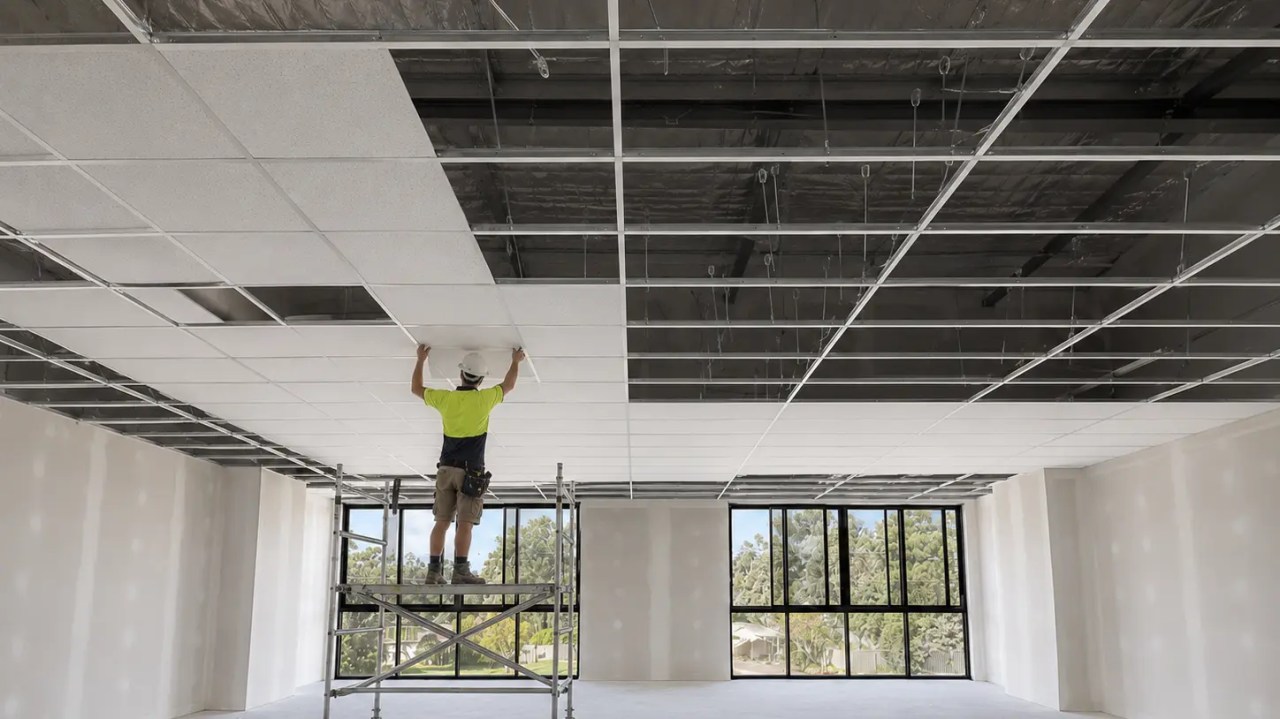
A proper replacement starts with containment, then removal, then installation of a hygienic ceiling system designed for healthcare use. In our CeilingPro projects, the best outcomes come from replacing not just the tile but also any fatigued grid components, brittle sealant, and old trims around services.
The new system should use antimicrobial or hygienic-rated boards, such as Bioguard-type acoustic tiles where appropriate, and the whole perimeter should be sealed so dust cannot migrate into the ceiling void or drop back into clinical space.
How do you replace antimicrobial tiles correctly?
The practical sequence matters more than most people think. If the room is still active, isolate it first, protect vents and adjacent surfaces, remove failed tiles with minimal breakage, vacuum the plenum with appropriate filtration, then install the new boards on a clean, stable grid.
For Perth clinics, we often specify moisture-tolerant, wipeable tiles with sealed edges where cleaning is frequent. If the space needs acoustic control as well, an acoustic medical panel is usually better than a hard nonporous board that makes the room louder and less comfortable for staff and patients.
Why does sealing the joints matter?
Open joints are where the trouble starts. Dust, insects, and fine debris can move through small lineal gaps that look harmless from the floor but act like funnels in the plenum.
A good seal does three things: it limits particle migration, improves wash-down performance, and reduces the chance that humidity from Western Australia’s seasonal conditions condenses inside the ceiling line. In practice, we aim for consistent sealant beads, tight cuts around penetrations, and no exposed raw edges where cleaning can’t reach.
Can acoustic performance and hygiene work together?
Yes, but only if the product is chosen for both goals. A silent room is not enough if the surface cannot be cleaned, and a cleanable surface is not enough if the room becomes harsh and echo-prone for staff.
Medical acoustic tiles solve this balance by combining sound absorption with a washable, antimicrobial finish. That is why CeilingPro often recommends a healthcare-rated acoustic tile in consulting rooms, reception areas, recovery zones, and dental treatment rooms where patient comfort and speech clarity matter.
What ceiling details are easy to miss?
The small details usually cause the big failures. Service cut-outs, recessed lights, access hatches, sprinkler escutcheons, and HVAC returns are the places where sealing quality gets lost.
In our field experience, the most common hidden issue is poor reinstatement after maintenance. A tile gets replaced, but the cut edge around a light fitting is left rough, the sealant line is broken, or a technician leaves the grid slightly twisted. That single defect can undermine the entire hygienic intent of the ceiling.
How should Perth facilities plan maintenance?
Facilities in Perth and Western Australia should plan ceiling maintenance around patient flow, humidity, and seasonal HVAC loading. Work is best scheduled during low-occupancy windows, with access control and dust containment built into the plan before any tile comes down.
Use a checklist that includes inspection of stain marks, edge condition, grid corrosion, sealant integrity, and evidence of repeated patch repairs. If a tile has been replaced more than once in the same location, the real problem may be moisture, roof leakage, or a service issue above the ceiling.
Does the local climate change material choice?
Yes. Perth’s hot summers and large temperature swings make material movement and HVAC strain more relevant than many owners expect. Ceiling products must handle repeated thermal cycling, cleaning, and occasional condensation without sagging or delaminating.
For Western Australia, that usually means specifying boards with strong dimensional stability, moisture resistance, and a finish that tolerates disinfectants without chalking. In older clinics with Gyprock-lined areas, the ceiling build-up should be reviewed carefully because not every board or joint system is suited to the same cleaning intensity.
What is the CeilingPro approach?
CeilingPro treats ceiling repair as a hygiene system, not a cosmetic patch. That means we look at the tile, the grid, the seal lines, the access method, and the service penetrations as one working assembly.
When we are called into Perth dental clinics or hospitals, we usually find the visible defect is only the end point of a broader issue: poor moisture management, worn suspension components, or repeated maintenance without proper resealing. Fixing the root cause saves repeat disruption and keeps the ceiling safer for longer.
CeilingPro Expert Views
“In healthcare ceilings, the cheapest tile is rarely the cheapest fix. If the joint is open, the penetration is loose, or the grid has started to fatigue, you are not buying a ceiling tile; you are buying a future maintenance problem. In Perth clinics, we’ve seen a properly sealed hygienic system outlast a patch job by years, especially where cleaning and air movement are constant. The real win is a ceiling that stays cleanable after the first repair, not just on the day it is installed.”
What are the best prevention steps?
The best prevention is regular inspection combined with fast action on minor defects. If a tile stains, bows, or loosens, replace it before the area becomes a recurring contamination point.
A practical prevention routine should include visual checks, humidity checks, grid inspection, and confirmation that sealant around services remains intact. CeilingPro often advises owners to log repeated defects by room so patterns become obvious early, especially in high-use Perth clinics.
FAQs
How often should medical ceiling tiles be inspected?
Inspect them at least quarterly, and more often in treatment-heavy rooms or any space with humidity, frequent cleaning, or overhead service work.
Can damaged tiles just be painted over?
Usually no. Paint may hide the defect, but it does not restore hygiene performance, edge stability, or sealed joints.
Are antimicrobial tiles enough on their own?
No. They help reduce surface growth, but the ceiling still needs proper sealing, clean installation, and routine maintenance.
What causes repeat staining above clinic ceilings?
Common causes include roof leaks, condensation, HVAC issues, or contaminants escaping through unsealed penetrations.
Should every clinic use the same ceiling type?
No. Treatment rooms, waiting rooms, corridors, and sterile areas often need different acoustic, cleaning, and moisture-performance levels.
Conclusion
A damaged medical ceiling should be treated as a hygiene and airflow issue, not a simple maintenance task. In Perth, Western Australia, the safest approach is to replace compromised tiles with a healthcare-rated system, seal every opening, and check the hidden causes that created the failure in the first place.
If the goal is a cleaner, quieter, longer-lasting result, CeilingPro recommends a full ceiling-line review rather than isolated patching. That is the difference between a quick repair and a ceiling that performs properly for years in real clinical conditions.
Related articles
 Soundproof Ceilings: What an Acoustic Upgrade Actually Buys YouKnowledge
 Fire-Rated Ceilings and Walls: Assemblies, Documentation and InspectionKnowledgeCeiling Insulation in Perth: Thermal Performance, Condensation and R-ValuesKnowledge
 Skim Coat and Ceiling Finishing: What a Level Finish Costs You in TimeKnowledge