Suspended Ceiling Tiles: System Choice, Tiles and What Sits Above the Grid
Suspended ceiling tiles are chosen for acoustic absorption, light reflectance, edge profile and moisture resistance, not appearance alone. How to specify them.
This page covers what a tile contributes to a suspended ceiling, how the main performance factors compare, and where tiles fail.
What a Suspended Ceiling Tile Has to Achieve
A tile has to sit in the grid without warping, contribute the acoustic and light performance the room requires, and remain in place while allowing access to the void above it.
The dimensional requirement is the first. Tiles are manufactured to the module the grid uses, and a tile that does not sit flat leaves visible gaps or edges that catch light. The tolerance matters more with a square edge, because the tile sits flush in the grid and any variation shows at the joint rather than being concealed by a shadow line.
The performance requirement is the second. Acoustic absorption reduces reverberation in open or busy rooms, which is why tile ranges are grouped by acoustic performance rather than only by face pattern. Light reflectance affects how much of the room’s lighting is returned from the ceiling, which matters in spaces where the ceiling is part of the lighting strategy. Where the ceiling forms part of a fire or acoustic separation, the tile is one component of a documented assembly rather than a stand-alone product.
The service requirement is the third. A suspended ceiling is expected to open for maintenance, and a tile that is difficult to lift, or that is damaged each time it is moved, becomes a maintenance cost. Edge profile and the way the tile sits in the grid decide how easily it can be lifted and how much the grid protects the tile edge during handling.
Suspended Ceiling Tiles: Types and How They Fit the Grid
Tiles differ in material, edge profile, face pattern and performance, and each of those interacts with the grid it is seated in.
The material determines weight, moisture behaviour and acoustic performance. Mineral fibre tiles are the common choice for acoustic absorption; they are light and easy to lift, and they are sensitive to moisture. Metal and gypsum-based tiles are used where durability, cleanability or a specific appearance is required, and they behave differently in humidity and in handling.
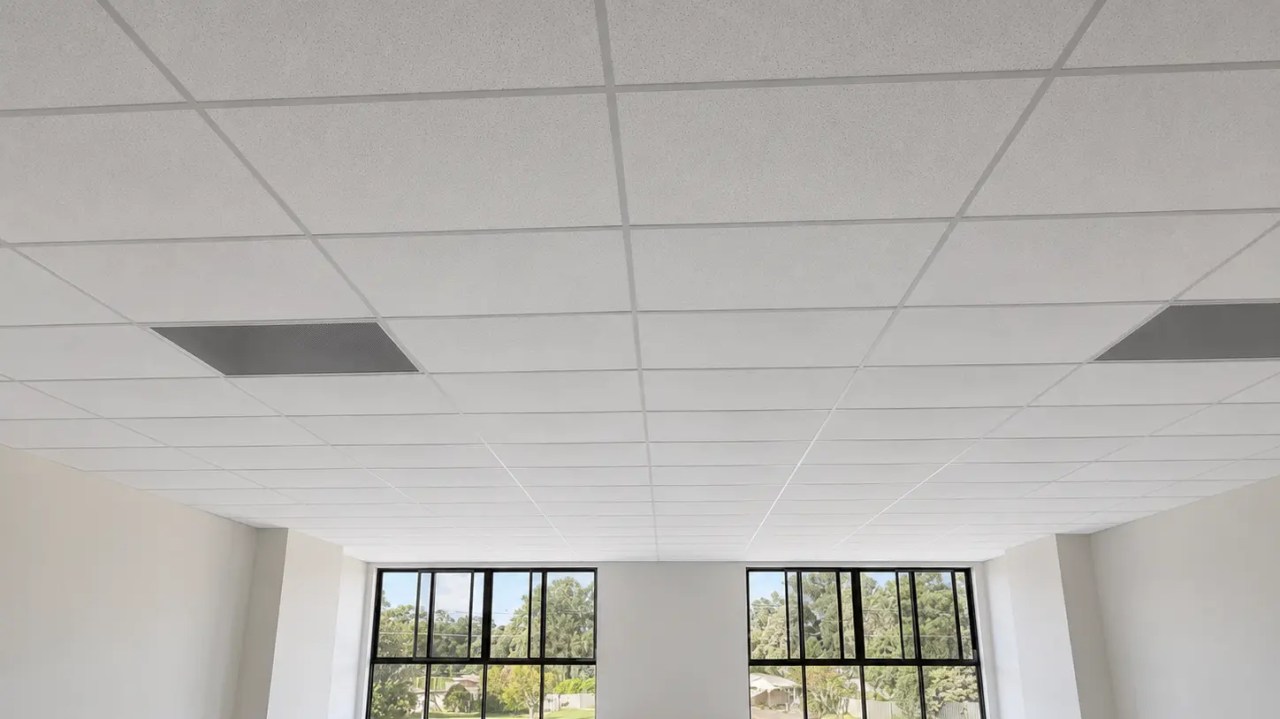
The edge profile decides how the grid reads. A square edge tile sits flush within the grid, producing a flat ceiling plane broken only by thin lines. A tegular tile drops below the grid and casts a shadow line, which makes the grid itself a visible part of the ceiling’s design. Concealed suspension removes the grid from view altogether and suits ceilings where a monolithic appearance is wanted, at the cost of more careful alignment during installation.
Face pattern and light reflectance complete the choice. Perforated and textured faces affect acoustic performance as well as appearance, and light-coloured faces return more light into the room. The manufacturer’s ceiling tile range groups tiles by these performance characteristics, which is the practical place to start a specification.
| Choice | What it changes | Where it matters most |
|---|---|---|
| Edge profile | Whether the grid is visible or hidden | Presentation areas versus service areas |
| Acoustic rating | Reverberation within the room | Open offices, teaching spaces, busy tenancies |
| Light reflectance | How much light returns from the ceiling plane | Deep-plan spaces with indirect lighting |
| Moisture resistance | Whether the tile holds shape in humid conditions | Kitchens, amenities, coastal or humid environments |
Selection Criteria That Actually Matter
The criteria are acoustic performance, humidity in the space, light strategy, cleanability and how often the void will be accessed.
Acoustic performance comes first in rooms with hard finishes, because the tile is often the only absorptive surface available. In a space where reverberation makes speech difficult, the tile specification changes the room’s usability more than any other ceiling decision.
Humidity is the second criterion and it is often overlooked. A mineral fibre tile in a humid space will take on moisture, soften and eventually sag. Where a suspended ceiling is required in a kitchen, an amenities area or an exposed coastal location, the tile and grid specification should both be suitable for the condition, and the same applies where the void itself is damp.
Cleanability and access complete the set. In a clinical or food-handling area, a standard permeable tile cannot be cleaned to the required standard, and a sealed tile and grid combination is specified instead. In a plant room or a services corridor, access frequency matters more than appearance, and a tile that is easy to lift and hard to damage is the better choice. Where the ceiling also forms part of a rated assembly, the assembly documentation governs and the tile is not substituted.
What Sits Above the Tiles
The void above the tiles carries the services and, in many buildings, forms part of the mechanical return air path.
Services are the first constraint. Ducting, pipework, cabling and fire protection are set out to the grid module so that each item lands where it can be reached, and the void depth is set by the deepest combination plus clearance. Where a service is added later, the penetration has to be made without disturbing the surrounding grid, and any rated or acoustic assembly has to be restored to its documented detail.
Return air is the second constraint. Where the void is used as a return air path, the tile becomes part of the mechanical system: permeability and sealing matter more, and the void cannot be subdivided arbitrarily. That role also affects how moisture behaves in the ceiling space, because air moving through the void carries humidity with it.
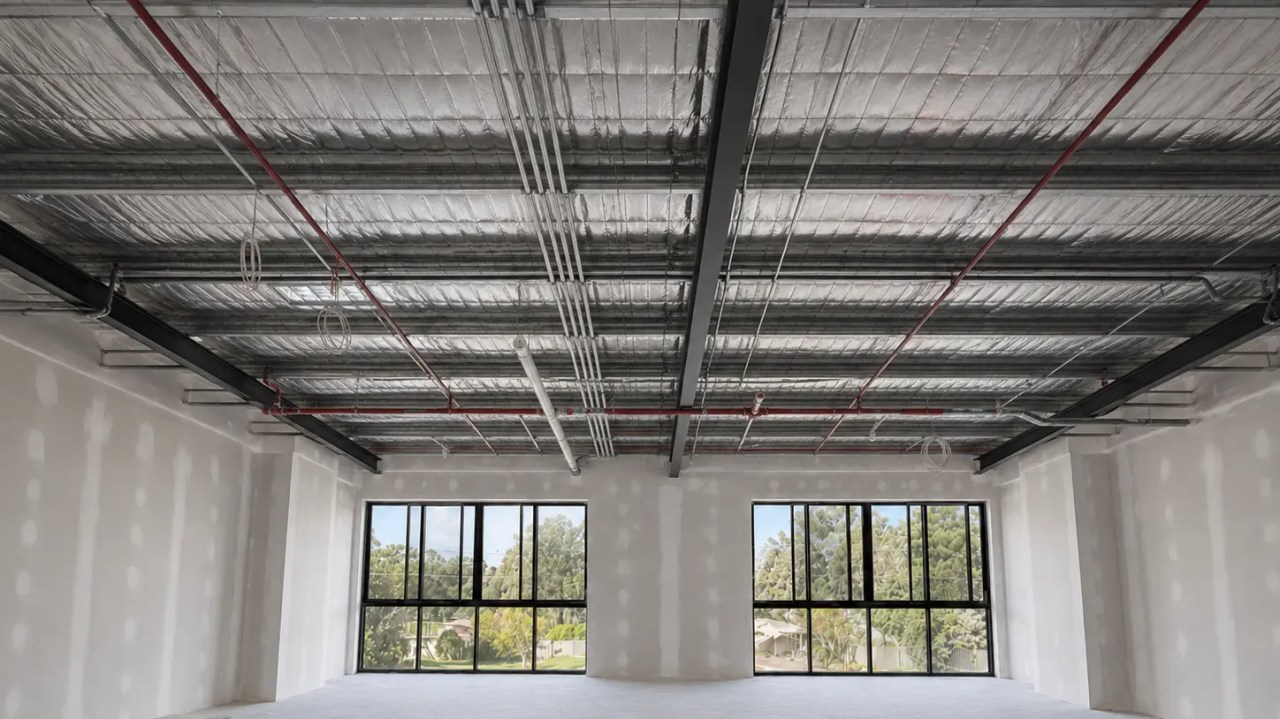
Structure and insulation are the third. Insulation laid on top of a suspended ceiling is sometimes used to improve thermal or acoustic performance, and its weight has to be within what the grid and suspension can carry. Where a ceiling has been used to support insulation or services beyond its design, the result is a grid that sags and tiles that no longer sit flat.
Installation Sequence and Trade Interfaces
The grid and services are set out and installed first, the tiles are seated once the services are complete, and the perimeter and transitions are finished last.
Services come before the tiles because installing a diffuser or a sprinkler head through a seated ceiling means lifting tiles repeatedly and risking damage to the edges. Where the services are being commissioned, the sequence matters as well: commissioning with the tiles out allows access without disturbing a finished ceiling.
The perimeter and transitions follow. Cut tiles around the perimeter are seated last, once the opening is confirmed, and the junction with any other ceiling type is finished so the two read as a designed change. Where a ceiling meets a partition, the head detail and the perimeter trim are installed as one operation so that neither disturbs the other.
Access and safety are part of the sequence. Working above a suspended ceiling means working at height, and the duties that apply are published by Safe Work Australia and by the state regulator. Where the void contains services that remain live, the work is coordinated with the trades responsible for them rather than carried out around them.
Inspection Points and Tolerances
Inspect the grid and services before the tiles are seated, the tiles as they go in, and the perimeter and transitions at completion.
The pre-tile inspection covers the suspension spacing and fixings, the level of the grid, the module set-out and the service positions. This is where an overloaded fixing or a grid out of level is corrected cheaply; once the tiles are in, correcting the grid means removing them and re-seating them afterwards.
The tiles themselves are checked for seating: that each sits flat, that the edges are undamaged, and that the pattern runs consistently across the ceiling. A tile that has been forced into place will not sit flat and will show under glancing light.
The completed inspection covers the perimeter cuts, the transitions to other ceiling types, and the access provisions. The tile and grid system documentation sets out the tolerances that apply, the sealing details for penetrations through rated assemblies are documented by manufacturers such as Promat, the component standards are published through Standards Australia, and the fire provisions that can apply to a suspended ceiling are summarised by the Australian Building Codes Board. Where the assembly is rated or acoustic, the penetrations and their sealing are part of the inspection rather than a separate item.

Where Tiles Fail in Service
Tiles fail by sagging, staining, edge damage and discolouration, and most of those are symptoms of a condition in the void rather than faults in the tile.
Sagging is usually a moisture symptom. Water in the void, a humid room, or condensation forming where warm air meets a cold surface all soften the tile, and the tile then bows. Replacing the tile without resolving the moisture reproduces the sag in the same place, usually within a season.
Staining points to water entering from above. A stain with a defined edge and a tide mark is evidence of a leak rather than of a tile defect, and the source is found before the tile is replaced. Where the source is a roof, a pipe or a mechanical unit, the repair belongs to that trade.
Edge damage accumulates with access. Every time a tile is lifted and re-seated there is a chance of damage to the edge, and a damaged edge is visible in the ceiling and reduces the tile’s acoustic performance. Keeping a small stock of matching tiles and recording the tile type means a damaged tile can be replaced with a match, which is much harder once the original range or batch is unknown. For the surrounding system, see the ceilings service page, with related guides under knowledge.
Frequently Asked Questions
What type of ceiling tile is best for a suspended ceiling?
The tile that matches the room’s dominant requirement: acoustic absorption in open or busy spaces, light reflectance where the ceiling should help distribute light, moisture resistance in humid areas, and a specified performance where the assembly is rated. Appearance follows those choices rather than leading them.
What is the difference between square edge and tegular tiles?
A square edge tile sits flush in the grid, so the ceiling reads as a flat plane with thin lines. A tegular tile drops below the grid and creates a shadow line, which makes the grid itself part of the ceiling’s appearance. The choice changes how visible the module is, not how the ceiling performs.
Why do ceiling tiles sag or stain?
Sagging usually follows moisture in the void, which softens the tile and allows it to bow, and staining usually indicates water entering from above rather than a fault in the tile. Both are symptoms of a moisture problem in the ceiling space, so replacing tiles without finding the source reproduces the defect.
What drives the cost of suspended ceiling tiles?
CeilingPro does not publish prices or price ranges. The scope depends on the area, the tile type and performance required, the grid module, the number of cuts around the perimeter and services, and whether the existing ceiling is being replaced or reconfigured.
If a Perth ceiling needs tiles specified for sound, light or moisture conditions, send the room’s use and the existing grid details through the CeilingPro enquiry form, or email info@ceilingpro.com.au.